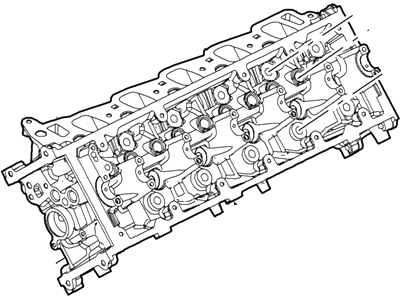
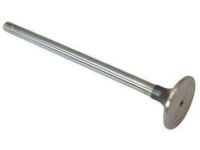
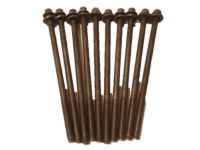
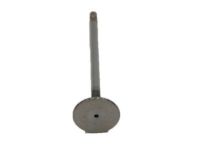
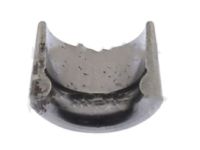
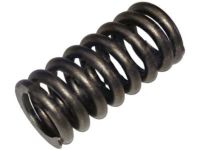
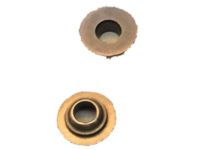
That procedure is the same to either cylinder head. Start by depowering the car and then lifting it to mount on a four-post lift, then proceed to remove the engine and place it on a heavy duty engine stand. Then, unbolt the fuel injector valve cover and uncover the rocker arms and pushrods; for the 6.0 L engines, the high pressure oil rail must be also unbolted. Pull off the fuel injection wiring connector off the rocker arm support and the crankcase tube and note that the 6.0L four-valve motor has valve bridges that may be removed here. Continue to the fuel injectors to be changed, and to do this, it is first necessary to drain any fuel remaining in the cylinder head, and high-pressure oil from the related system as a sign of the engine's damage. If not already done, take off the exhaust manifold. Then remove the cylinder head bolts in the reverse sequence with which they were tightened; the 6.0L diesel engine bolts and dowel pins used are nonadjustable. Cylinder head can best be removed by an engine hoist or you can get help, also dispose off the old cylinder head gasket. Remove all residue of old gasket material on the cylinder head as well as on the mating surface of the engine block, scrub and air-dry the threads of the cylinder head bolts as well as the bolt holes. Put on a new gasket and the cylinder head therefore ensuring that the gasket is not damaged in the process. In 6.0L and 6.4L Diesel engines, new head bolts and dowels, coated lightly with oil, installed and tightened by using sequence number. The remainder of the installation procedure is the reverse of the removal procedure; care must be taken when re-torquing the high-pressure oil rail. Last of all, after reconstructing the head until it is ready for the final assembly, then refit the engine.