

My Garage
My Account
Cart
Genuine Mercury Lynx Exhaust Valve
Exhaust Muffler Valve- Select Vehicle by Model
- Select Vehicle by VIN
Select Vehicle by Model
orMake
Model
Year
Select Vehicle by VIN
For the most accurate results, select vehicle by your VIN (Vehicle Identification Number).
1 Exhaust Valve found
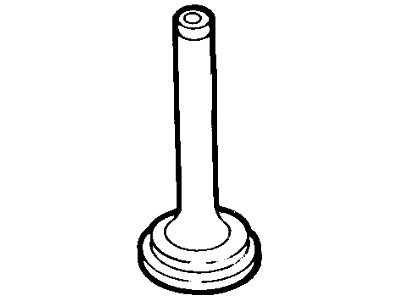
Mercury Lynx Exhaust Valve
The Mercury Lynx Exhaust Valve lets burned gases out so the compact engine generates plenty of power and runs clean. Opening immediately after the power stroke, this Exhaust Valve follows the camshaft lobe. In the original overhead valve (OHV) versions, it does so through a chain of lifter, pushrod, and rocker, while later overhead cam (OHC) versions have the cam right above the valve or on a light bucket follower, shortening the path and reducing friction. Mercury provided both layouts during production. No matter the design, the Exhaust Valve should seal tight until commanded to open because any leakage robs compression and the small Mercury four-cylinder of acceleration. Heat is the maximum enemy of the valve. When the temperature climbs, the valve can burn, warp, or crack, causing Lynx to idle rough, misfire, and have poor mileage. The Exhaust Valve is kept closed by stout springs that exert up to 200 pounds of pressure when fully opened. As a result, the valve will not float at high rpms to the point it can kiss a piston. Each Lynx with the later configuration revs more quickly, while the early Lynx works with proven pushrod pieces, and constant clearance keeps any Lynx quiet as the Exhaust Valve prevents excessive lash, allowing Mercury owners to enjoy steady torque.
We provide a wide range of Mercury Lynx Exhaust Valve at the optimal prices. If you need Mercury Lynx Exhaust Valve, you can shop with confidence on our website. All our OEM parts come with a manufacturer's warranty and are delivered to your doorstep with a fast delivery service.
Mercury Lynx Exhaust Valve Parts Questions & Experts Answers
- Q:What is the significance of a professional performing a valve job on the Exhaust Valve and Intake Valve of a Mercury Lynx?A:Owing to the sensitive operations of the job and the special tools and equipment involved, the work that involves resurfacing of the valves, valve seats, and the valve guides which is normally called the valve job should be conducted by an expert mechanic. It also enables a home mechanic perform a basic 'tear down' of the head, carry out initial preparation of cleaning and inspection before reassembling for transport to a dealer service department or an auto machine shop where the actual service is done. The inspection enables the understanding of the status of head and valve train parts; the work needed and new components when dealing with an automotive machine shop. Dealer service department or automotive machine shop can perform the following on valves: valve and springs are removed, valves and valve seats are recondition or replaced, valve guides are reconditioned, valve springs, spring retainers and keepers checked and replaced as required, new valve seals are installed, valve components are reassembled, installed spring height is checked and corrected if necessary. Also, depending on the condition, the surface of the cylinder head gasket will be restored if warped. After the valve job has been done by a professional, head will be as good as new. On its return it should be cleaned again before being bolted onto the engine to remove any loose metal particles and fine abrasive grit that may be left after the service of valves or a resurfacing of the head; and if possible, use compressed air to blow out all the oilways and passages.
Related Mercury Lynx Parts
 Mercury Lynx Cylinder Head Gasket
 Mercury Lynx Cylinder Head Bolts
 Mercury Lynx Rocker Arm
 Mercury Lynx Intake Valve