My Garage
My Account
Cart
Genuine Ford Fairmont Drive Belt
Serpentine Belt- Select Vehicle by Model
- Select Vehicle by VIN
Select Vehicle by Model
orMake
Model
Year
Select Vehicle by VIN
For the most accurate results, select vehicle by your VIN (Vehicle Identification Number).
4 Drive Belts found

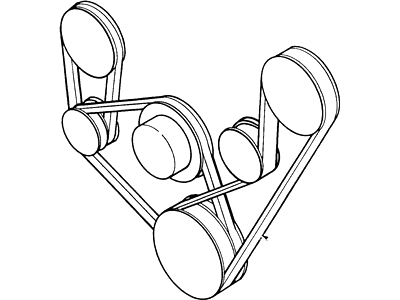
Ford Fairmont Drive Belt
The engine's crankshaft power goes to essential components like the A/C compressor and alternator via the Ford Fairmont Drive Belt. This Drive Belt wraps over pulleys and transfers rotation with up to 98 percent efficiency while absorbing sudden changes in load. The first generations of Fairmont deployed several V-belt loops to drive components, while later cars adopted a single serpentine Drive Belt routing one continuous path around all components. The design of the serpentine system prevents slippage, works with some misalignment, and also speeds up under-hood work unlike the multiple V belts applied in Ford engines. Both designs operate from minus 35 to 85 degrees Celsius and usually last near 100,000 miles. Replacement of your Drive Belt is essential if fraying, cracking, or glazing occurs. If you're neglecting your Drive Belt wear, you could be killing your battery charge or cabin cooling. Ford Fairmont owners should give their assembly a glance for correct tension and ribs in good order. When the Drive Belt is healthy, the Ford powertrain remains calm, and every Fairmont component spins harmoniously.
We provide a wide range of Ford Fairmont Drive Belt at the optimal prices. If you need Ford Fairmont Drive Belt, you can shop with confidence on our website. All our OEM parts come with a manufacturer's warranty and are delivered to your doorstep with a fast delivery service.
Ford Fairmont Drive Belt Parts Questions & Experts Answers
- Q:What is the purpose and method of adjusting drive belts on Ford Fairmont?A:Drive belts are used to drive all ancillaries including the cooling fan, alternator, Thermactor pump, air conditioning pump and power steering pump. The belts vary in size and design, according to function. Belts are considered stretched after ten minutes of use and must be adjusted. Ford Motor Company and its subsidiaries do not use "inches of belt deflection" as a means of determining belt adjustment, but use 'pounds of adjustment. This is determined by use of a tensionometer, available from an authorized Ford dealer. The "pounds of tension" is based on the design of the belt being tested. Belts are of three types; V-belts, cogged belts and V-ribbed belts. The V-ribbed belt is differentiated by the appearance of its inner surface which appears to be made up of several V-belts placed side by side. Drivebelt adjustment should be performed in the following manner. Locate each of the belts and measure the width. Using the tensionometer, adjust the belt to the tensions given in the Specifications at the beginning. If no tensionometer tool is available, belts can be adjusted using a straightedge and a ruler as shown in Fig. 3.15. Belts with a free span of less than twelve inches should have a deflection of between t and inch (3 to 6 mm). The deflection of a belt with a span greater than twelve inches should be between and in (3 to 9 mm). Vehicles equipped with ribbed belts must only be checked with the tensionometer because of the higher tension used with this type of belt. The deflection testing method described is not valid on these belts. Drive belts should be inspected periodically for fraying, glazed or burned appearance. To adjust a drivebelt, loosen the bolt(s) on the component the belt is driving and, using a suitable pry bar, hold tension on the belt while the bolt is tightened. Check the belt tension after tightening. To remove a drivebelt, loosen the adjusting bolt and push the component inward toward the engine until the belt can be removed. Installation is the reverse of removal and the belt should be retensioned after ten minutes of running.