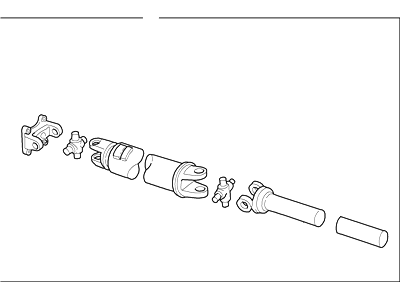
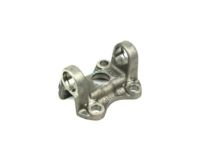
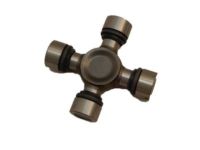
The driveshaft is a tube between the transfer case or transaxle and the rear and front axles; it has two universal joints to permit power transmission to the wheels at different angles. In long wheelbase models, it is composed of two shafts connected by a universal joint and maintained by a bearing. Some driveshafts have a splined slip yoke at one end, allowing it to slide in and out to adjust to suspension movement in case of length changes; on a front slip yoke, an oil seal prevents fluid loss and possible contamination; if this happens, the oil seal must be changed. Driveshaft assemblies need minimal service, universal joints on models that do not include grease fittings are lubricated for their use, and they should be replaced if there is a problem; this means removing the assembly from the car. The driveshaft has to be kept clean as well as checked for damages and the state of balancing weights before reassembly where in it has to be put back in the same manner to retain balance. Issues with the driveshaft can be as simple as hearing or feeling a new noise or vibration while driving; a road test can then be done to diagnose if the driveshaft is the problem or if there is another issue entirely. Another way of determining whether the universal joints are badly worn is to drive slowly, take the vehicle over choke, and accelerate, listening for clanking noises; or raise the vehicle and rotate the drive shaft and look for some looseness in the universal joint.